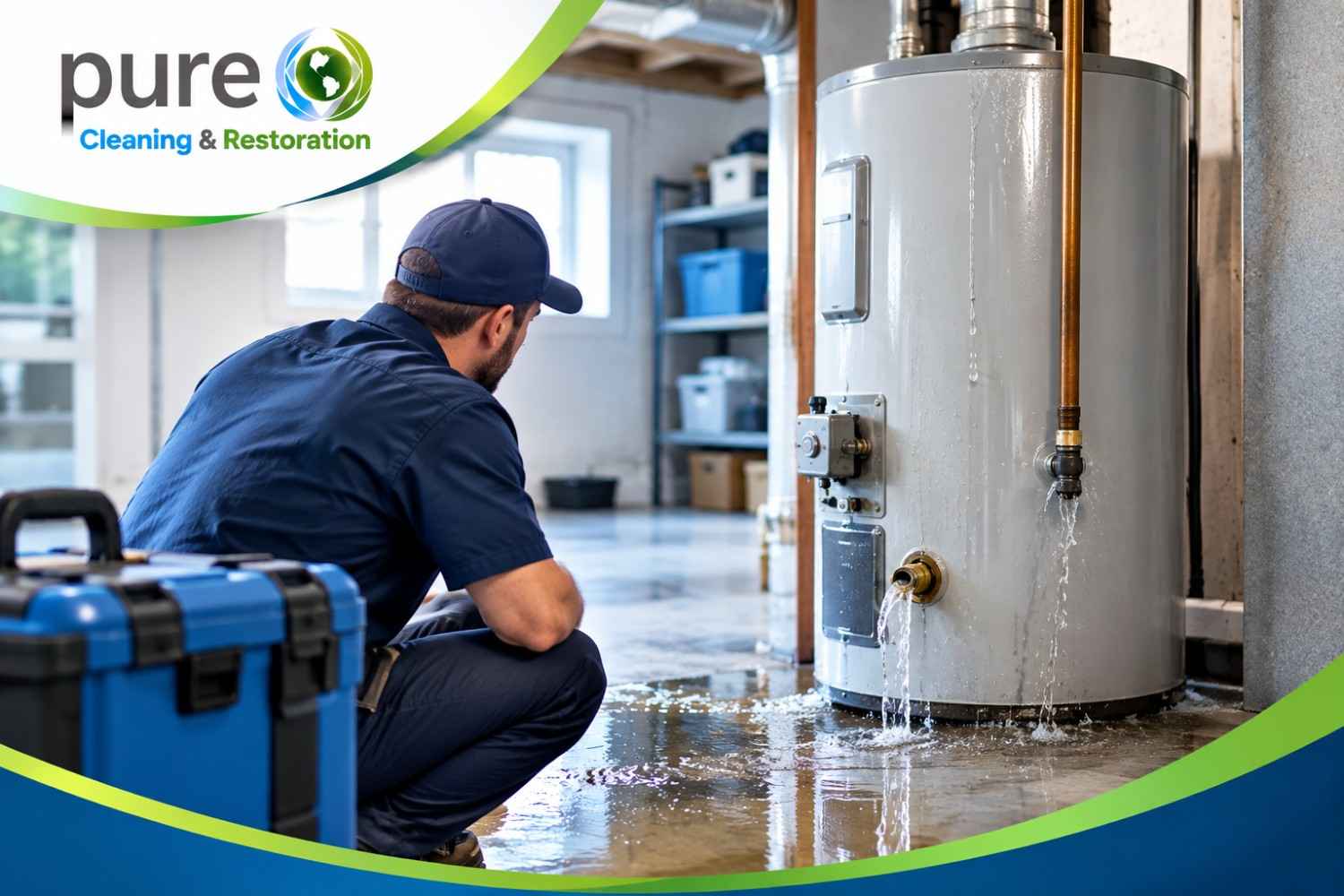
Short answer: If your water heater bursts or leaks, first turn off its power or gas, then shut off the cold water supply to the tank. Next, stop any electrical risk near the water, photograph the damage, and start removing water right away. Call a restoration company if more than a small puddle has spread, because wet drywall and flooring can grow mold within 24 to 48 hours.
A water heater failure is stressful because it happens fast. A 40- to 50-gallon tank can empty onto your floor in minutes, and the supply line keeps feeding it until you shut the water off. The steps below put safety first, then walk you through stopping the water, limiting the damage, and deciding who to call.
Step 1: Stay Safe Before You Touch Anything
Water and electricity do not mix. Before you wade into the room, check these points.
- Do not step into standing water if outlets, cords, or the electrical panel might be wet. If the water is deep or near the panel, stay out and call an electrician or your utility.
- Do not touch the hot water. Water from a tank can be hot enough to scald. The U.S. Consumer Product Safety Commission says water at 140°F can cause a third-degree burn in about six seconds, and water at 150°F in about two seconds, according to its tap water scald safety alert.
- Keep kids and pets out of the room.
If you have a gas water heater
Gas heaters add two more risks: a gas leak and carbon monoxide.
- If you smell gas (a rotten-egg odor), leave the home right away. Do not flip switches or use a phone inside. Call your gas utility or 911 from outside.
- If a carbon monoxide alarm sounds, or anyone feels dizzy, nauseous, or has a headache, get fresh air immediately. The EPA advises opening doors and windows, turning off fuel-burning appliances, leaving the home, and seeking emergency medical care. Its guide to carbon monoxide poisoning lists gas water heaters among the appliances to watch.
Step 2: Shut Off the Power or Gas to the Heater
Turning off the energy source stops the heater from firing with no water in the tank, which can damage it and create a hazard.
| Heater type | How to shut it off |
|---|---|
| Electric | Switch off the water heater’s breaker at the electrical panel. Only do this if you can reach the panel while standing on dry ground. |
| Gas | Turn the gas control knob to “Off” or “Pilot,” and turn the gas shutoff valve a quarter turn so the handle sits crosswise to the pipe. |
| Tankless | Turn off the power (or gas), then close the water valves on the unit. |
Step 3: Stop the Water Supply
A leaking tank keeps refilling until you close the cold water inlet.
- Find the cold water shutoff valve on the pipe entering the top of the heater (usually marked with blue).
- Turn a lever handle a quarter turn so it sits crosswise to the pipe. Turn a round handle clockwise until it stops.
- If the valve is stuck, leaking, or under water, go to your main water shutoff, usually near where the line enters your home, by the water meter, or in the garage or basement.
Everyone in the household should know where the main shutoff is. If you are not sure, find it today, before you need it. Our guide on how to prevent costly water damage shows how to mark it.
Step 4: Figure Out Where the Water Is Coming From
The source tells you what happens next. Look closely, but only after the power or gas and water are off.
| Where the water appears | What it often means | What to do |
|---|---|---|
| Pipe connections at the top | A loose or worn fitting, or a failed supply line | A plumber can often fix this. The tank may be fine. |
| Temperature and pressure (T&P) relief valve or its discharge pipe | The valve is releasing pressure, or has failed | Call a plumber. Do not cap or plug this valve. It is a safety device. |
| Drain valve near the bottom | A loose or worn valve | A plumber can replace it, but check the tank for rust. |
| Base or bottom of the tank | The tank itself has corroded or cracked | Replacement is usually needed. |
| Rust-colored streaks down the sides | Corrosion from the inside | Plan to replace the unit soon. |
A small drip from a fitting is very different from a split tank. If the tank is leaking from the body or base, repairs rarely hold, and replacement is the safe choice. A licensed plumber can confirm this.
Step 5: Document the Damage Before You Clean
Your insurance company will ask for proof. Take two minutes now.
- Photograph the heater, the water line on the walls, and every wet item.
- Take a short video walking through the whole area.
- Write down when you found the leak and when you shut the water off.
- Keep damaged items until the adjuster says you can toss them, unless they are unsafe.
- Save plumber and restoration receipts.
For more on this, see our upcoming insurance claims guide (coming soon).
Step 6: Remove Water and Protect What You Can
Speed matters. The EPA’s brief guide to mold and moisture says to dry water-damaged areas and items within 24 to 48 hours to prevent mold growth.
What you can do right away:
- Move belongings out. Lift furniture, boxes, and electronics to dry ground. Put foil or plastic under furniture legs on wet carpet.
- Mop and towel up shallow water. For a few gallons on a hard floor, a mop and towels are enough.
- Use a wet/dry vacuum for larger puddles. Never plug it in while standing in water, and use a properly grounded outlet on a dry circuit.
- Open windows and run fans if the weather allows. In Utah’s dry air, this helps the surface, but it does not dry what is inside walls or under flooring.
- Pull up soaked area rugs and hang them to dry.
What not to do:
- Do not turn on the water heater again to “test” it.
- Do not use a household vacuum on water.
- Do not leave soaked carpet padding in place. It holds water against the subfloor.
- Do not assume it is fine because the surface looks dry. Water travels into baseboards, drywall, and under flooring.
How Bad Is a Water Heater Leak? Three Common Scenarios
A slow drip from a fitting. You may have a damp spot around the base. This is usually a plumbing fix plus a good drying, especially if it has been dripping for days.
A steady leak from the tank. Expect wet flooring, baseboards, and possibly drywall within minutes. This usually needs a new heater and professional drying.
A burst tank. A full tank can release dozens of gallons quickly. If the heater sits in a basement, closet, garage, or utility room off living space, water can reach carpet, subfloors, and nearby rooms. In a finished basement, this is a full water damage job. Our basement flood cleanup page explains how that process works.
Is the water “clean”?
Water from a supply line or a heater tank starts out as clean water. But clean water does not stay clean. If it sits on carpet, padding, or drywall, it can pick up contaminants, and mold can begin to grow. A heater that sits near a floor drain, sewage line, or a dirty basement floor can also mix with other water. We explain how water is classified in our upcoming guide on water damage categories (coming soon).
When to Call a Plumber vs. a Restoration Company
Most water heater leaks need both, in the right order.
| Call a plumber when… | Call a restoration company when… |
|---|---|
| The heater is leaking and needs repair or replacement | Water has spread past the immediate area |
| A valve or fitting is failing | Carpet, padding, drywall, or flooring is wet |
| You are not sure how to shut off the water or gas | Water has been sitting for more than a few hours |
| The T&P valve is discharging | You see or smell mold, or the room feels damp days later |
| You want a new heater installed | You need documentation for an insurance claim |
Do the plumbing first so the leak stops, then dry the structure. If water is still coming in, drying equipment is wasted. If you are not sure how far the water went, a restoration crew can use moisture meters to find wet areas you cannot see.
Pure Cleaning and Restoration handles this drying work through our water damage restoration service across the Wasatch Front, with 24/7 emergency response. We use professional extraction and drying equipment, and we document the work for your insurance company.
What Professional Water Heater Cleanup Looks Like
Here is what a typical restoration visit involves:
- Safety check. The crew confirms power, gas, and water are off and the area is safe.
- Water extraction. Truck-mounted or portable pumps and extractors remove standing water.
- Moisture mapping. Meters and thermal imaging find water inside walls, floors, and ceilings.
- Removal of unsalvageable materials. Soaked padding, and wet drywall or insulation at the bottom of walls, may need to come out.
- Structural drying. Air movers and dehumidifiers dry the space. Crews check readings daily until materials reach normal moisture levels.
- Cleaning and sanitizing. Affected areas are cleaned. Carpets that can be saved are cleaned with our carpet cleaning service after they dry.
- Final readings and paperwork. You get documentation for your records and your insurer.
If drying is slow or incomplete, mold can follow. Our mold removal team can inspect if you notice musty smells or discoloration after a leak.
What Does It Cost?
The total depends on two separate jobs: the heater itself and the water cleanup. Replacement cost varies by heater type, size, and the plumber’s pricing, so get written quotes. Cleanup cost depends on how much water spread, what materials got wet, and how long it sat. Our water damage restoration cost guide breaks down the factors that drive the price so you can compare quotes fairly.
Does Insurance Cover a Water Heater Leak?
Many standard homeowners policies cover sudden and accidental water damage, such as a tank that bursts. They often do not cover the heater itself if it failed from age or lack of maintenance, and they may deny slow leaks that went on for weeks or months. Policies differ, so read yours or ask your agent. Report the loss quickly, keep your photos, and keep receipts.
Warning Signs Your Water Heater Might Fail Soon
Most tank water heaters last about 10 to 15 years. Hard water, which is common along the Wasatch Front, can speed up mineral buildup inside the tank. Watch for:
- Moisture, rust, or puddles around the base.
- Rusty or cloudy hot water.
- Popping, rumbling, or banging sounds from sediment in the tank.
- A heater older than about 10 years.
- Corroded fittings or pipes around the top.
- Not enough hot water or water that stays lukewarm.
If you see several of these, ask a plumber to look at it before it fails on its own schedule.
How to Prevent a Water Heater Disaster
- Inspect it every few months. A quick look at the base and connections takes a minute.
- Flush the tank once a year, following the manufacturer’s directions, to remove sediment.
- Test the T&P relief valve as the manufacturer recommends, and replace it if it does not work.
- Set the temperature to 120°F. The CPSC recommends this setting to reduce scald risk, and it also saves energy.
- Put a drain pan with a pipe to a drain under the heater if it sits above finished space.
- Consider a leak sensor or an automatic shutoff valve. A small battery alarm on the floor can warn you early.
- Replace the heater on your schedule, not when it fails at 2 a.m.
If you manage a building, our commercial water damage prevention checklist (link once live) covers heaters and other high-risk systems.
Frequently Asked Questions
What should I do first if my water heater bursts? Turn off the power or gas to the heater, then shut off the cold water supply valve on top of the tank. If the valve will not close, shut off your main water line. Stay out of standing water if electrical outlets or the panel may be wet. Then photograph the damage and start removing water.
Can I shut off the water to just the water heater? Yes. Most heaters have a cold water shutoff valve on the pipe entering the top of the tank. Closing it stops new water from flowing in. If it will not close, use your home’s main shutoff.
Why is my water heater leaking from the bottom? A leak from the base often means the tank has corroded or cracked from the inside, which usually means replacement. Sometimes the water is coming from the drain valve or a fitting above and running down, so a plumber should confirm the source.
Is a leaking water heater dangerous? It can be. Standing water near electrical power is a shock risk, hot water can scald, and a gas heater can add gas leak and carbon monoxide risks. Turn off the power or gas, stay out of deep water, and get fresh air if you smell gas or feel ill.
How much water can a water heater release? A typical tank holds about 40 to 50 gallons, and a burst can release most of that quickly. A supply line that keeps feeding the tank can add more, which is why shutting off the water matters.
Will homeowners insurance cover water heater damage? Often it covers sudden, accidental water damage to your home, but not the cost of the heater itself if it wore out. Slow leaks are often excluded. Check your policy, report the loss quickly, and keep photos and receipts.
How long do I have before mold grows? The EPA recommends drying wet materials within 24 to 48 hours to prevent mold growth. After that, the risk rises, especially in drywall, carpet pad, and insulation.
Final Thoughts
A water heater failure is manageable if you act in the right order: stay safe, shut off the power or gas, stop the water, document the damage, and dry the space fast. The heater is usually the smaller part of the cost. The bigger risk is water that sits in walls and floors after the leak is “fixed.”
Water on the floor from a heater leak? Call Pure Cleaning and Restoration at (801) 750-2928 for 24/7 emergency water removal and drying anywhere along the Wasatch Front.
Related Reading on Our Site
- How to Prevent Costly Water Damage
- Water Damage Restoration Cost Guide
- Flooded Kitchen: What to Do First (add link once live)
- Bathroom Flooding: Toilet Overflow and Shower Leak Steps (add link once live)
External Sources Used
- U.S. Consumer Product Safety Commission, Tap Water Scalds (scald times, 120°F recommendation): https://www.cpsc.gov/s3fs-public/5098-Tap-Water-Scalds.pdf
- U.S. EPA, Protect Your Family and Yourself from Carbon Monoxide Poisoning: https://www.epa.gov/indoor-air-quality-iaq/protect-your-family-and-yourself-carbon-monoxide-poisoning
- U.S. EPA, A Brief Guide to Mold, Moisture, and Your Home (24 to 48 hour drying): https://www.epa.gov/mold/brief-guide-mold-moisture-and-your-home