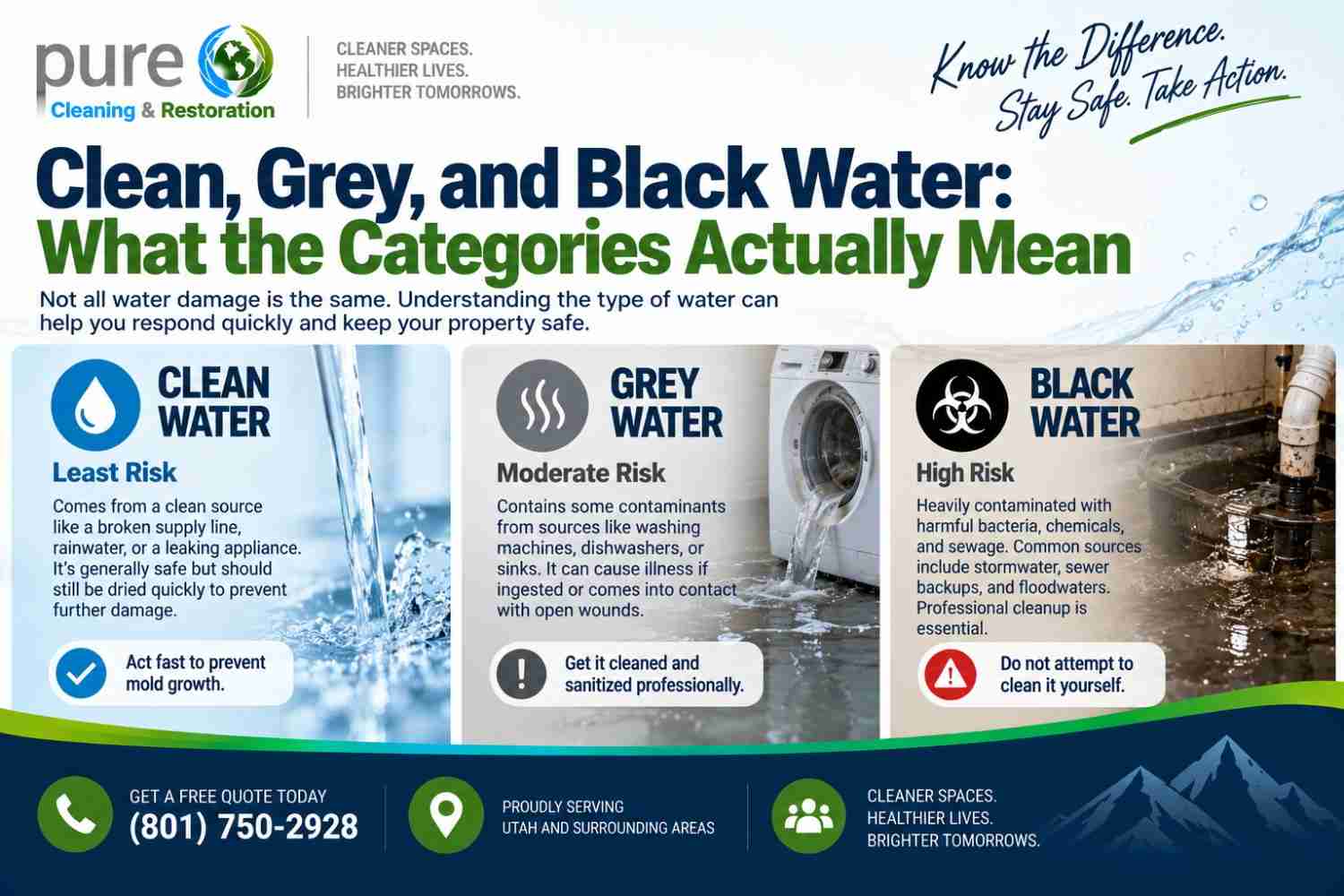
Actually Mean
If water has ever crept across your floor, your first thought probably wasn’t about terminology. But once a restoration company gets involved, you’ll likely hear a phrase like “Category 2 water” or “this is black water” – and that classification isn’t just industry jargon. It directly determines how the cleanup is handled, what can be saved, and how quickly it needs to happen.
The Three Categories, Defined
The Commonwealth of Massachusetts’ official building water damage guidance – reflecting the same classification system used industry-wide – breaks water damage into three categories based on contamination level, not just where the water came from:
Category 1 – Clean Water Water from a sanitary source with no significant contamination. This includes rainwater penetrating through a roof or window, leaks from HVAC or heating systems (without antifreeze), and leaks from steam pipes, water heaters, or plumbing supply lines. This is the least hazardous category and the easiest to fully restore.
Category 2 – Grey Water Often called grey water, this category contains chemical or biological contamination that could cause illness on contact. Sources include dishwasher or washing machine overflow, sump pump failures, and toilet overflow involving urine but no fecal matter. Materials affected by Category 2 water are harder to salvage than Category 1.
Category 3 – Black Water The most contaminated category. Black water contains pathogens and poses a genuine health risk – ingestion or significant exposure can result in serious illness. Sources include sewage, toilet backflow involving fecal matter, rising floodwater from rivers or streams, surface water entering a building, and water from heating systems containing antifreeze.
Why the Category Matters More Than the Amount of Water
A small amount of Category 3 water is a more serious situation than a large amount of Category 1 water. This is the part that surprises people: the category, not the volume, determines the response. A few inches of sewage backup requires specialized handling regardless of how contained the area is, while a much larger volume of clean water from a burst supply line can often be handled with standard extraction and drying.
This is also why the same fixture can produce different categories of water depending on exactly what happened – a toilet tank overflow (Category 1, clean) versus a toilet bowl backup involving waste (Category 3, black water) is a distinction worth knowing before assuming any toilet-related flooding is the same kind of problem.
Does the Category Change Over Time?
Yes, and this matters for response speed. Clean Category 1 water that isn’t addressed within roughly 24 to 48 hours can begin degrading into Category 2 as microbial growth increases, meaning a delayed response can turn an easier cleanup into a more complicated one, even without any new contamination being introduced. This is one of the more practical reasons restoration guidance consistently emphasizes acting quickly rather than waiting to see if a wet area dries on its own.
What This Means for What Can Be Saved
- Category 1: Materials generally have the best chance of being fully dried and salvaged, including carpet, drywall, and most furnishings, provided drying begins promptly.
- Category 2: Salvageability drops. Porous materials that absorbed grey water often need to be removed rather than dried in place, since the contamination is harder to fully remove from the material itself.
- Category 3: Porous materials that contacted black water – carpet, drywall, insulation, upholstered furniture – generally cannot be safely salvaged and need to be removed and disposed of, regardless of how the surface looks after cleanup.
Why This Affects How You Should Respond
- Category 1 situations are often reasonable to begin addressing yourself – stopping the source, removing standing water, starting airflow – while still monitoring for full drying.
- Category 2 situations call for more caution, particularly around direct contact and full removal of affected porous materials rather than just drying and reusing them.
- Category 3 situations should not be treated as a DIY cleanup under any circumstances. This requires professional handling with proper protective equipment and disposal protocols – see our guide on what to do during a sewer backup for the specific steps if you’re dealing with this right now.
Frequently Asked Questions
What’s the difference between grey water and black water?
Grey water (Category 2) contains chemical or biological contamination from sources like appliance overflow or sump pump failure, and can cause illness on contact. Black water (Category 3) is far more contaminated, containing pathogens from sources like sewage or floodwater, and poses a serious health risk.
Can clean water turn into a more contaminated category over time?
Yes. Category 1 clean water left unaddressed for roughly 24 to 48 hours can begin degrading toward Category 2 as microbial growth increases, which is part of why quick response matters even for water that started out clean.
Is a toilet overflow always considered black water?
No. A toilet tank or supply line overflow is Category 1, clean water. A toilet bowl backup involving waste is Category 3, black water. The distinction depends on the specific source, not just which fixture was involved.
Can I clean up Category 2 or 3 water myself?
Category 2 calls for more caution than Category 1 and often requires removing affected porous materials rather than drying them in place. Category 3 should not be treated as a DIY situation at all – it requires professional handling with proper protective equipment and disposal.
Why do restoration companies talk about “category” instead of just how much water there is?
Because contamination level, not volume, determines both the health risk and what can realistically be saved. A small amount of Category 3 water is more serious than a much larger amount of Category 1 water.
Final Thoughts
The category of water involved in a flood or leak – not the amount of it – is what actually determines how serious the situation is and how it needs to be handled. Clean water gives you the most room to act and the best chance of saving affected materials; grey water calls for more caution; black water requires professional handling without exception. Knowing which category you’re dealing with is the first real question to answer before deciding what to do next.
Not sure what kind of water damage you’re dealing with? Call (801) 750-2928 – we’ll help you understand the situation and the right response.