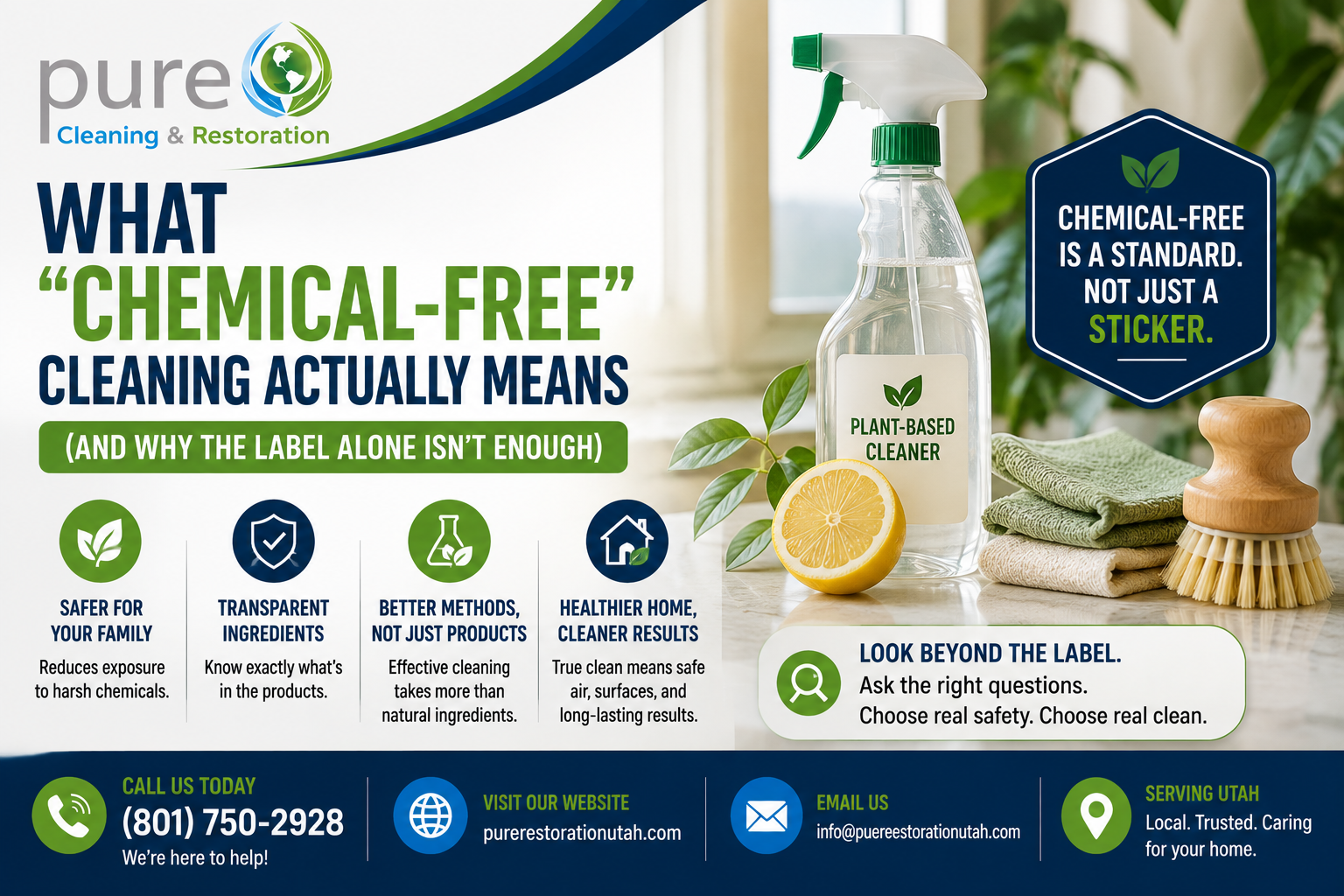
Walk through almost any cleaning company’s website and you’ll see the same phrase: chemical-free, eco-friendly, non-toxic, safe for kids and pets. It’s become such a standard claim that it barely registers anymore — which is exactly the problem. The term gets used so loosely that it’s worth understanding what it actually means, because the honest answer is a little more nuanced than the marketing copy usually lets on.
The Uncomfortable Truth: Nothing Is Actually “Chemical-Free”
Here’s the part most cleaning companies won’t say out loud: water is a chemical. Vinegar is a chemical. Literally everything you clean with, natural or synthetic, is made of chemicals — that’s just what matter is. “Chemical-free” as a literal claim doesn’t hold up to scrutiny, and it’s been criticized by advertising standards bodies in other countries for being misleading for exactly this reason.
That doesn’t mean the underlying idea is meaningless. What people actually care about — and what the phrase is trying to communicate — is something more specific: products without harsh synthetic ingredients, without high concentrations of volatile organic compounds (VOCs), and without residue that could irritate skin, trigger allergies, or affect indoor air quality. That’s a real and worthwhile distinction. It’s just not accurately described as “chemical-free.”
What Actually Matters: VOCs and Certification, Not Marketing Language
The more useful question isn’t “is this chemical-free?” — it’s “does this product meet an actual, verifiable safety standard?” The clearest answer available is the EPA’s Safer Choice label, a voluntary certification program that reviews every ingredient in a product against strict criteria for human health and environmental impact.
To carry the Safer Choice label, a product must:
- Have every intentionally added ingredient individually reviewed by EPA scientists for safety
- Meet restricted VOC limits specifically to reduce indoor air pollution and respiratory irritation
- Pass pH standards that limit skin and eye irritation risk
- Meet sustainable packaging requirements
- Disclose all ingredients, including fragrance components, either on the label or publicly online
Fewer than 2,000 products currently qualify for this label out of the enormous number of cleaning products on the market — which tells you something about how high the bar actually is, and how much easier it is for a company to simply say “eco-friendly” than to use products that have cleared this review.
Why VOCs Are the Detail That Actually Matters
Volatile organic compounds are chemicals that evaporate easily at room temperature — which is exactly why they’re a concern indoors. Many conventional cleaning products release VOCs into the air during and after use, and higher concentrations are associated with respiratory irritation and other health effects, particularly for people with asthma, allergies, or chemical sensitivities. This is the specific, measurable thing that “chemical-free” marketing is usually gesturing toward, even when the phrase itself isn’t precise.
This is also why a product being “natural” or “plant-based” doesn’t automatically mean it’s low-VOC or gentle on indoor air — those are separate claims, and only a real certification standard actually verifies VOC content rather than just asserting it.
Questions Worth Asking Instead of Trusting the Label
If a cleaning company markets itself as eco-friendly, chemical-free, or non-toxic, these questions get you a more useful answer than the marketing phrase itself:
- “Are your products EPA Safer Choice certified, or is that a general claim?” A yes/no answer here tells you whether the claim is backed by independent review or just word choice.
- “Can I see the ingredient list?” Safer Choice-certified products are required to disclose full ingredients — if a company can’t or won’t share this, that’s worth noting.
- “What specifically makes this safer for kids and pets?” A specific answer (low VOC, no added fragrance, pH-balanced) is more meaningful than a general reassurance.
- “Does ‘eco-friendly’ apply to all your services, or just some?” Some companies use certified products for one service and conventional products for another — worth clarifying if it matters to you.
Why This Matters More for Some Households Than Others
For most households, the difference between a conventional cleaning product and a Safer Choice-certified one is a modest, sensible upgrade. For a few groups, it matters more directly:
- Households with young children or pets, who spend more time at floor level in direct contact with treated surfaces
- People with asthma or chemical sensitivities, for whom VOC exposure can be a genuine symptom trigger, not just a comfort preference
- Homes with poor ventilation, where residue and off-gassing from cleaning products has less opportunity to disperse
If none of these apply strongly to your household, the choice matters less — but it’s still reasonable to want an accurate answer rather than a vague marketing phrase either way.
What This Means for Choosing a Cleaning Provider
The honest takeaway isn’t that “chemical-free” claims are dishonest across the board — it’s that the phrase alone doesn’t tell you much. A provider who can point to actual EPA Safer Choice certification, explain their specific product choices, and answer direct questions about ingredients is giving you something verifiable. A provider who only offers the phrase itself is asking you to take their word for it.
At Pure Cleaning and Restoration, our carpet, upholstery, rug, and restoration services use products chosen specifically for low-VOC content and family and pet safety, and we’re happy to answer specific questions about what we use and why — not just repeat the general claim.
Frequently Asked Questions
Is “chemical-free” cleaning actually a real thing?
Not literally — everything is made of chemicals, including water. What the phrase usually refers to is products without harsh synthetic ingredients or high VOC content, which is a real and meaningful distinction, just not accurately described by the term itself.
What does EPA Safer Choice certification actually verify?
It confirms that every ingredient in a product has been individually reviewed by EPA scientists for human health and environmental safety, that VOC content is restricted, and that the product meets pH and packaging standards — a much higher bar than a general “eco-friendly” claim.
Are natural or plant-based cleaning products automatically low-VOC?
Not necessarily. “Natural” and “low-VOC” are different claims, and only a verified certification like Safer Choice actually confirms VOC content rather than just implying it.
Does chemical-free cleaning work as well as conventional products?
Products certified under EPA Safer Choice are required to pass performance testing showing they clean comparably to conventional products — the certification doesn’t allow companies to sacrifice effectiveness for safety.
How can I verify a company’s eco-friendly claims are legitimate?
Ask directly whether their products are EPA Safer Choice certified, request to see an ingredient list, and ask what specifically makes the product safer. A specific, verifiable answer is a good sign; a vague reassurance is worth following up on.
Final Thoughts
“Chemical-free” is a phrase that says more about marketing habits than it does about what’s actually in a bottle. The more useful standard is whether a product has been independently verified — EPA Safer Choice certification, disclosed ingredients, and restricted VOC content are things you can actually check, unlike a general claim on a website. Asking a cleaning provider a specific question instead of trusting the label is the difference between hoping a company is being accurate and actually knowing.
Want to know exactly what’s in the products used in your home? Call (801) 750-2928 — we’re glad to answer specific questions, not just repeat the marketing version.
Related Reading on Our Site