If you deal with unexplained sneezing, congestion, or itchy eyes at home — even when pollen counts outside are low — the source might be closer than you think. Carpet, area rugs, and upholstered furniture are some of the most effective allergen reservoirs in a typical home, and most people never think about them the way they think about pollen or pet fur on the couch cushions.
This isn’t about deep-cleaning paranoia. It’s about understanding what’s actually accumulating in soft home surfaces and what genuinely helps versus what just feels productive.
Why Carpet and Upholstery Trap Allergens So Effectively
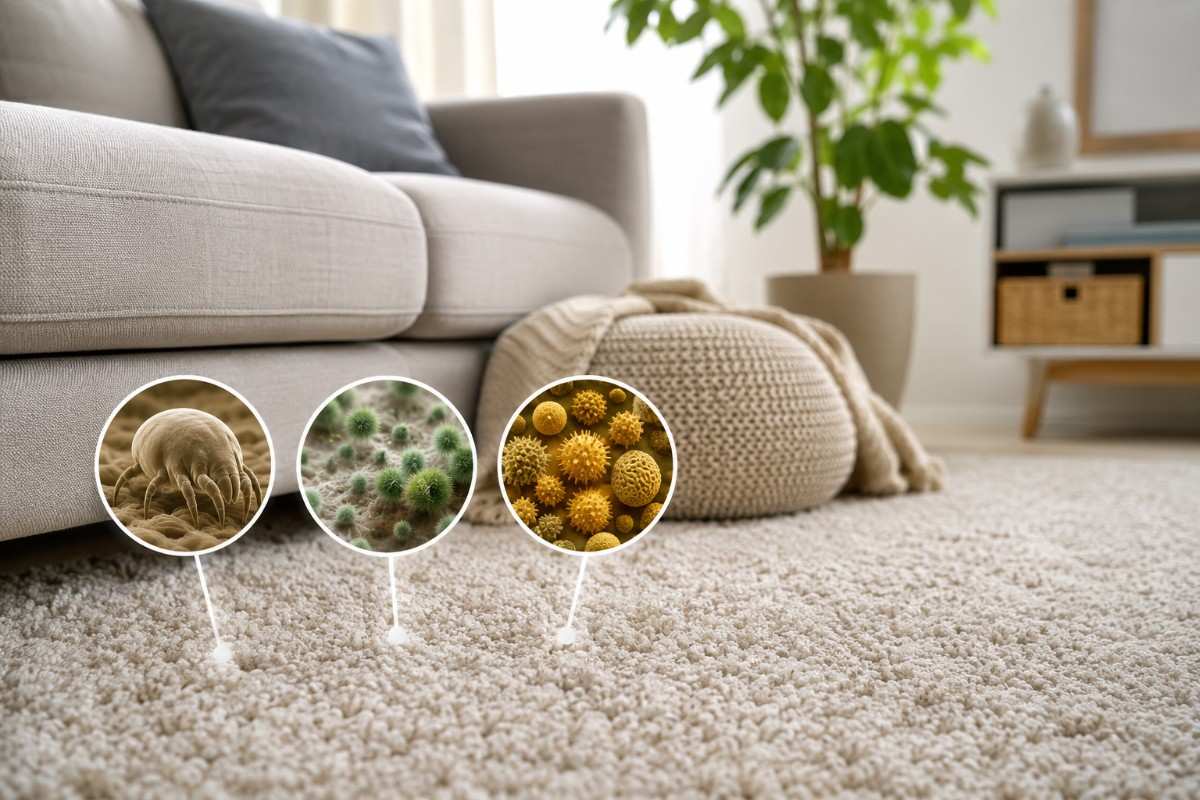
According to the American Lung Association, dust mite allergens don’t stay airborne the way pollen does — instead, they settle quickly into fabric and dust, and carpets, upholstered furniture, and curtains act almost like nests for them. That’s very different from how most people picture an “allergen problem,” which is usually something floating in the air rather than something embedded in the furniture.
The Asthma and Allergy Foundation of America notes that roughly 8 out of 10 people in the U.S. are exposed to dust mites, and about 6 out of 10 are exposed to cat or dog dander — meaning nearly every home has some level of these allergens present, whether or not anyone in the household has noticed symptoms yet.
The Most Common Indoor Allergens Living in Soft Surfaces
- Dust mites — microscopic organisms that feed on shed skin cells and thrive in warm, humid conditions. They’re found almost exclusively in fabric: carpet, upholstery, mattresses, and curtains.
- Pet dander — tiny flecks of skin shed by cats, dogs, and other pets, small enough to stay embedded in carpet and fabric fibers long after the pet has moved to another room.
- Mold spores — particularly in carpet or upholstery that’s experienced any past moisture exposure, even minor spills that seemed to dry completely.
- Pollen and outdoor particulates — tracked in on shoes, clothing, and pet fur, then settling into carpet fibers rather than staying on hard flooring.
Why Vacuuming Alone Doesn’t Fully Solve the Problem
This is the part that surprises most people: vacuuming, while important, isn’t a complete solution on its own. The U.S. EPA notes that vacuuming can actually increase airborne levels of dust mite allergens and other particles temporarily, since the process disturbs settled dust and sends some of it back into the air rather than removing all of it. The EPA specifically recommends that allergic individuals leave the room during and shortly after vacuuming for this reason.
This doesn’t mean vacuuming isn’t worth doing — regular vacuuming with a HEPA-filtered vacuum is still one of the most important baseline habits for allergen control. It just means vacuuming alone, especially with a standard (non-HEPA) vacuum, doesn’t fully remove what’s embedded deep in carpet and upholstery fibers the way deeper extraction cleaning does.
Practical Steps That Actually Reduce Allergen Exposure
- Vacuum weekly with a HEPA-filtered vacuum. The EPA and American Lung Association both recommend HEPA filtration specifically, since it captures the fine particles a standard vacuum filter lets pass back into the air.
- Wash bedding weekly in hot water. The EPA recommends water above 130°F to effectively kill dust mites — most standard warm-wash settings don’t reach this temperature.
- Control indoor humidity. The EPA notes that keeping indoor relative humidity below 45% specifically helps limit dust mite populations, since mites thrive in warm, humid conditions and struggle to survive in drier air.
- Use washable throw rugs where possible, especially in bedrooms, since they can be laundered far more easily than wall-to-wall carpet.
- Damp-dust hard surfaces regularly rather than dry dusting, which can resuspend particles into the air rather than removing them.
- Schedule periodic deep extraction cleaning for carpet, rugs, and upholstery. Professional hot-water extraction reaches allergen material embedded deep in fibers and padding that routine vacuuming — even with a HEPA filter — typically can’t fully access.
A Note on Pet Dander Specifically
Pet dander behaves differently than dust mite allergen in one important way: unlike mite allergen, dander can stay airborne longer and travels more easily throughout a home, settling on soft surfaces in rooms pets rarely enter. This is why allergy symptoms sometimes persist even in homes where pets are kept out of bedrooms — dander has often already spread well beyond the areas a pet physically occupies.
When to Consider Professional Cleaning
A few situations where professional deep cleaning tends to make a meaningful, noticeable difference:
- Someone in the household has diagnosed allergies or asthma, and symptoms seem worse at home than elsewhere.
- It’s been over a year since carpet, rugs, or upholstery were deep-cleaned, since allergen buildup is gradual and easy to underestimate.
- The home has pets, especially multiple pets, given how effectively dander embeds into fabric over time.
- A room has ever experienced a spill, leak, or humidity issue, even one that seemed to dry without incident, since mold spores can develop in padding or backing that isn’t visible from the surface.
Our professional carpet cleaning and upholstery and rug cleaning services use hot-water extraction that reaches material trapped deep in fibers and padding, well beyond what home vacuuming can access, with chemical-free options available for households managing allergies or sensitivities.
Frequently Asked Questions
How often should carpet be professionally cleaned for allergy control?
Most households benefit from professional extraction cleaning every 12 months, with more frequent service worthwhile for homes with pets, young children, or someone managing diagnosed allergies or asthma.
Does vacuuming make allergies worse in the short term?
It can, temporarily. The EPA notes that vacuuming can resuspend dust mite allergens and other particles into the air during and shortly after the activity, which is why allergic individuals are often advised to leave the room during vacuuming and let the air settle afterward.
Is carpet worse for allergies than hard flooring?
Carpet does trap and hold more allergen material than hard flooring, since dust mite allergen and pet dander settle into fibers rather than staying on the surface where they’re easier to remove. That said, removing carpet isn’t the only solution — regular HEPA vacuuming and periodic deep extraction cleaning can substantially reduce allergen levels without replacing flooring.
What humidity level helps control dust mites?
The EPA recommends keeping indoor relative humidity below 45% for mite-allergic individuals specifically, since dust mites thrive in warm, humid environments and their populations decline in drier conditions.
Can pet dander cause allergy symptoms even if the pet stays out of certain rooms?
Yes. Pet dander tends to spread more widely throughout a home than dust mite allergen, often settling in rooms the pet doesn’t regularly occupy, which is why symptoms can persist even with pet-free zones in place.
Final Thoughts
Carpet, rugs, and upholstery are some of the most effective allergen traps in a typical home, holding onto dust mite allergen, pet dander, and other particles far more persistently than hard surfaces. Regular HEPA vacuuming, humidity control, and hot-water bedding washes form a solid baseline, but for allergen material embedded deep in fibers and padding, periodic professional extraction cleaning reaches what routine home cleaning generally can’t.
Managing allergies or asthma at home and want a deeper clean than vacuuming alone can provide? Call (801) 750-2928 for a free estimate, or explore our full range of cleaning services for homes across the Wasatch Front.